

The short answer
Wheel fitment comes down to three numbers: width, offset (how far the mounting face sits from the wheel’s centreline) and tire size. Lower offset pushes the wheel outward, higher offset tucks it in. The right spec is found by measuring from the hub face to the fender, the strut and the inner arch at full lock and full compression, then choosing a wheel that uses that space without touching anything. Guessing from someone else’s build is how cars end up rubbing.
The three numbers
- Width: measured between the bead seats, in inches. A 13-inch-wide wheel needs a tire designed for that width, or you get stretch or bulge.
- Offset: the distance in millimetres between the mounting face and the centreline of the wheel. Positive offset tucks the wheel in toward the suspension; lower or negative offset pushes it out toward the fender.
- Backspacing: the distance from the mounting face to the inner lip. It is the measurement that tells you whether the wheel will hit the strut or control arm.
Bolt pattern and centre bore must match the hub, and the lug nut seat must match the wheel. Those are not fitment questions; they are safety questions.
How we measure
With the car at its final ride height and the suspension loaded, we measure from the hub face outward to the fender edge and inward to the nearest suspension component, at straight ahead and at full lock each way. Then the suspension is compressed to its bump stop and measured again. Those numbers, minus a safety margin, define the widest wheel and lowest offset that can live there. Only then do we look at catalogues.
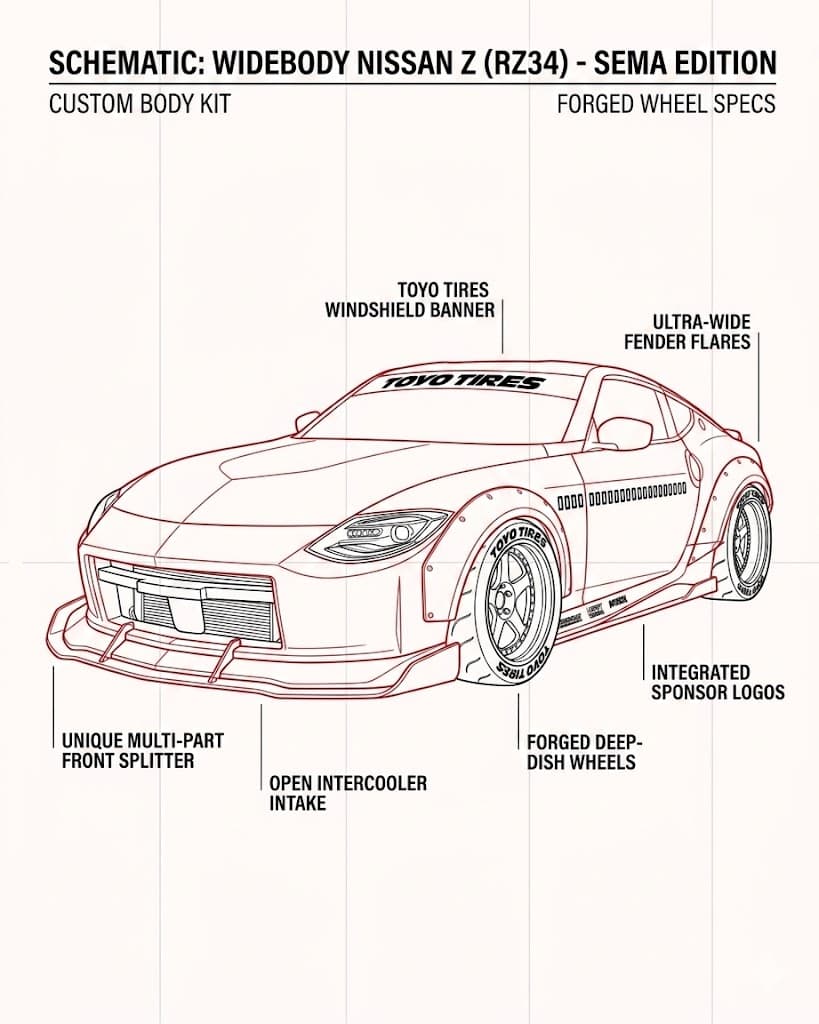
On the Z, the Kuhl Racing flares added enough width that an 18x11 front and 18x13 rear SSR Professor SP6 could sit under them on 275/35 and 315/30 Toyo R888R tires. The measurement said so before the wheels were ordered, and the road test confirmed zero rub at full lock.
Stretch, poke and camber
A tire narrower than the wheel is “stretched”; it gains clearance at the fender lip but reduces the contact patch and sidewall protection. A wheel that sits outside the fender is “poke”, which is illegal in some places and throws stones at your own paint. Negative camber tucks the top of the wheel in and can rescue a tight fit, at the cost of inner tire wear. We use all three sparingly and tell you what each one costs.
Spacers and adapters
A hub-centric spacer can correct a wheel whose offset is slightly too high. It cannot fix a wheel that is the wrong width, and stacked or non-hub-centric spacers are a vibration and safety problem. If a spacer is more than a small correction, the wheel is wrong.
Bring us the car, not a screenshot
Fitment threads and “will these fit” calculators assume a stock car at stock height. Yours is not. Book a fitment measurement, bring the wheels you are considering if you have them, and we will give you the spec in writing.